Bubble Bus: Parking Jam Puzzle
- 4.6
- Rating
- 1.00M
- Installs
- Free
- Price

 Analysis by App-foxy
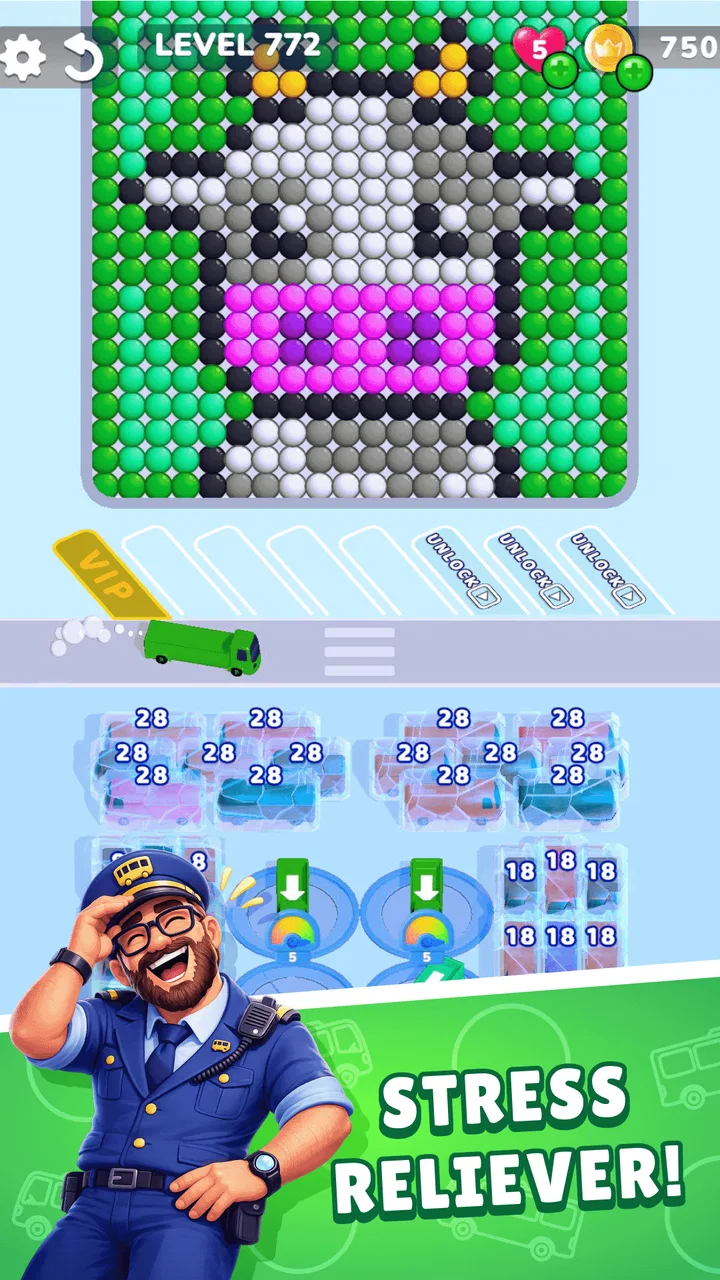
Bubble Bus: Parking Jam Puzzle is the kind of mobile game I open when I want a quick mental reset rather than a long, demanding session. It turns a crowded traffic situation into a color-matching puzzle: buses need to be paired with the right bubble colors, and the player has to sort the jam without making the board impossible to clear. The idea is easy to understand, but the order of each move is where the real challenge begins.
I reviewed it as a casual puzzle game, paying particular attention to how quickly it gets into a playable state, how it feels during repeated sessions, and whether it remains comfortable on older devices. My overall impression is positive. It is free to start, rated for Everyone, and published by MOONEE PUBLISHING LTD. The game has reached over 500 thousand installs and holds a 4.6 average from around 4.9 thousand ratings, which fits my experience: this is a very accessible game with a simple hook and enough planning to keep it from feeling completely automatic.
How the puzzle feels in real play
The first thing I noticed is how little explanation the central idea needs. You look at the buses, identify the matching colors, and try to release or arrange them in a sensible sequence. That makes it a good choice for a short break, especially when I do not want to learn a complicated control scheme or remember a large set of rules.
You May Also Like

 Blood Strike: 2.5 Anniversary
Blood Strike’s Loadouts Turn Every Drop Into a Tactical Gamble
A close look at Blood Strike’s custom loadouts: how fast access to signature weapons reshapes its battle royale rhythm, rewards preparation, and narrows the gap between fights.

 Pandora - Music & Podcasts
Pandora’s Music Is Easy to Start, but Harder to Recover
Pandora’s strength is its low-effort path from a seed to a station. Its weak spot is how much confidence it asks you to place in connection, setup, and quiet recovery.

 8 Ball Pool
 Is Built on Rivalries, Rematches, and Routine
A close look at the rivalries, rematches, shared routines, and unanswered safety questions that turn a quick pool match into a persistent mobile community.

 Samsung Music
’s Quiet Strength Is Playing What You Already Own
Its reach comes less from spectacle than from dependable access to a personal library. That simplicity is both the app’s strongest retention engine and its ceiling.

 AccuWeather: Weather Radar
AccuWeather Review: A Quick, Clear Forecast for Everyday Decisions
For everyday plans, the best forecast is the one you can understand quickly. AccuWeather makes rain timing, radar, and local conditions easy to act on, with a few trade-offs.

 Hill Climb Racing
Why Hill Climb Racing Still Turns Crashes Into One More Run
A tiny car, a bumpy hill and one more upgrade: Hill Climb Racing keeps resurfacing because its simple chaos makes every near-miss feel personal.
More From Our News Desk



The simplicity is also where the game’s speed comes from. A round can move from observation to action quickly, and the basic interaction does not demand long menus or extensive preparation. For me, that makes it more suitable for waiting rooms, short commutes, or the few minutes before an appointment than puzzle games that require a large uninterrupted block of concentration.
That does not mean every board feels equally quick. The early decisions are usually obvious, while busier layouts require me to pause and inspect the available colors before touching anything. A move that looks efficient can block the next useful match, so the pace naturally changes from fast sorting to deliberate planning. I like that contrast because it gives the game a small tactical layer without turning it into a complicated strategy title.
One practical tip is to avoid treating the first available match as automatically correct. I get better results when I scan the whole visible arrangement first and ask which color has the fewest safe options. Clearing that color early can prevent a later bottleneck. This is a small habit, but it makes the game feel less like random tapping and more like controlled traffic management.
The color-based design also makes the objective readable at a glance. I can return to a board after briefly looking away and usually understand what needs attention. That matters on a phone, where interruptions are common. The game works best when I want a focused but lightweight task, not when I am looking for a story, character development, or a large world to explore.
What happens during longer sessions
Bubble Bus is strongest in short bursts, but I can also play several rounds in succession when I am in the mood for repetitive sorting. During heavier use, the main demand is not complex controls; it is visual attention. I spend more time checking possible sequences, comparing color positions, and deciding whether a seemingly helpful move will create a dead end.
That makes the game surprisingly useful as a small concentration exercise. I sometimes play it after stepping away from work because the rules are simple enough to enter quickly, while the board still asks me to think ahead. It is not a substitute for a deep logic game, but it gives my attention a clear, bounded problem instead of leaving me to scroll without purpose.
There is a trade-off, though. If you prefer constant novelty, the matching-and-sorting structure may begin to feel repetitive. Its appeal depends on enjoying the process of arranging traffic and improving your decision order. Players who need changing objectives, action, or a strong progression system may find the core loop too narrow, even if the individual puzzles become more demanding.
When I play for a longer stretch, I find it better to stop after a frustrating board rather than repeatedly making hurried moves. Because the puzzle depends on sequence, impatience can make the same layout feel harder than it is. Taking a short pause and restarting with a full scan is more useful than tapping faster. That is one of the game’s less obvious lessons: speed helps only when the plan is already clear.
Another useful approach is to separate “available now” from “safe later.” A bus or color may be ready to match immediately, but using it can remove the space needed for a more constrained group. I try to reserve flexible moves until I know which part of the board is most restricted. This is especially helpful when several colors appear to have similar opportunities and the board’s order matters more than the individual match.
Stability and recovery after interruptions
For everyday use, reliability matters as much as the puzzle itself. I often open casual games in situations where a notification, phone call, or quick app switch can interrupt me. Bubble Bus suits that pattern better than a game that expects a long continuous session, because its basic activity is easy to understand when I return.
The game is currently listed as version 2.8, and it supports devices running Android 7.1 or later. Those details make it more approachable for people who are not using a recent phone, although the actual experience will still depend on the device’s age and condition. I would not assume that every older handset will feel identical, but the operating-system requirement is not aimed only at the newest hardware.
When a puzzle is interrupted, my main concern is whether I can quickly work out what I was doing. The visual arrangement helps with that: I can inspect the board again instead of recalling a complicated sequence of abilities or story objectives. For short sessions, this kind of recovery is valuable. It lowers the cost of putting the phone down and picking the game up again.
I would still avoid beginning a delicate puzzle move when I know I am about to be interrupted. The game rewards planning, and losing concentration at the wrong moment can lead to an avoidable mistake. That is not a technical criticism so much as a consequence of the design. Its recovery is mentally simple, but the board can still punish a move made without attention.
In terms of perceived responsiveness, the straightforward interaction works in its favor. There is no need for me to manage a large set of controls, so the game feels easy to approach during ordinary use. I would describe it as a light puzzle experience rather than a resource-heavy game, but I would not make a universal claim about battery life, heat, or loading time across every phone. Those results can vary considerably with hardware, background activity, and the condition of the device.
Older phones, storage choices, and practical limits
The minimum Android requirement of 7.1 gives Bubble Bus a wider potential device range than games built only for current operating systems. That is good news if you keep an older phone for casual gaming. Still, an older operating system does not guarantee a perfect experience. A phone with limited free space, a crowded background workload, or a worn battery may behave differently from a newer device running the same software.
My practical advice is to treat it as a modest casual game, but to leave enough breathing room on the phone for normal operation. If the handset already struggles when switching between apps, the issue may appear more clearly during repeated play. Closing unnecessary background activity before a longer session is a sensible step, especially on older hardware.
The game is free to download and play, which removes the biggest barrier to trying it. There are in-app purchases ranging from $1.49 to $99.99 per item, so I would pay attention to the purchase flow if children use the device. The Everyone age rating makes the game broadly approachable, but that rating should not be confused with unrestricted spending. I recommend enabling the device’s purchase protections before handing the phone to a younger player.
This is also where Bubble Bus differs from a completely offline paper puzzle or a basic preinstalled brain teaser. A free mobile game can be convenient and polished, but it may also include monetization choices that some players would rather avoid. If your priority is a distraction with no possible purchase pressure, a traditional puzzle book or a paid, self-contained alternative may suit you better.
For families, the color-matching premise is easy to demonstrate. I can explain the objective in a few seconds, then let another person try to find the safest order. That makes it more approachable than many logic games with abstract symbols or layered rules. However, younger players may focus on immediate matches instead of planning, so the best way to play together is to ask what move should come next and why, rather than simply taking over the board.
Where it beats ordinary puzzle alternatives
Compared with a traditional match-three game, Bubble Bus feels less dependent on making large combinations or chasing visual effects. The appeal is closer to organizing a constrained space. I prefer it when I want my decisions to matter in sequence, not when I want a stream of quick rewards and constant board changes.
Compared with a pure sorting game, the bus theme gives the puzzle a clearer sense of purpose. I am not just moving colored objects around; I am trying to untangle a traffic problem. That framing is small, but it helps the activity feel more directed. It also makes the game easier to recommend to someone who enjoys tidy-up puzzles but does not want a complicated simulation.
On the other hand, a deeper logic title will usually offer more variety in rules and more room for advanced solving techniques. Bubble Bus is better when I want immediate accessibility and a low learning curve. If I am looking for layered deduction, elaborate campaign design, or a puzzle that changes its logic dramatically from one stage to the next, I would choose something more specialized.
It also differs from action-oriented parking games. There is no reason to approach it expecting driving controls, realistic traffic physics, or a vehicle simulator. The traffic theme is a visual and logical framework for arranging colors. That distinction matters because the game is satisfying for planning, not for steering or speed.
The strongest reason to try it is the balance between instant readability and small but meaningful planning decisions. I can understand the goal immediately, yet I still have to think about order, space, and future options. That balance is difficult to get right in a casual puzzle, and it is the part I would mention first when recommending it to a friend.
Who should install it, and who should skip it
I would recommend Bubble Bus to anyone who enjoys short sorting puzzles, color-based challenges, and games that can be played without a long tutorial. It is particularly suitable for players who want something calm enough for a break but not so passive that every move feels automatic. Its Everyone rating also makes it approachable for a broad audience, provided purchase controls are handled responsibly.
It is a good fit for an older Android phone that still runs everyday apps but is not intended for demanding 3D games. The Android 7.1 minimum makes it worth considering on compatible older hardware, though I would keep expectations realistic about performance on a device with limited resources. The game’s simple premise should help it feel less intimidating than a large modern release.
I would skip it if you dislike repeating one central mechanic, want a story-driven experience, or prefer puzzles with no in-app purchase option at all. I would also look elsewhere if your main goal is a serious logic challenge with many distinct systems. Bubble Bus has enough planning to stay interesting, but its strength is focused casual play rather than depth across many puzzle genres.
For a realistic everyday scenario, imagine having ten minutes before a train arrives. I can open the game, solve a board or two, and stop without needing to remember a plot or prepare a loadout. If the train arrives halfway through a decision, I can put the phone away and inspect the arrangement again later. That combination of quick entry and understandable recovery is more useful to me than a game that technically offers more content but demands uninterrupted attention.
My performance verdict
After spending time with it, I see Bubble Bus as a focused casual puzzle rather than an all-purpose mobile game. Its perceived speed comes from the simple objective and direct color-based decisions, while its heavier moments come from planning the order of moves on crowded boards. The game does not need a complicated interface to create friction; the challenge is deciding which apparently useful action should wait.
Its device profile is reasonably approachable because it supports Android 7.1 and later, and the game is free to try. I would still judge the experience by the phone itself rather than the operating-system requirement alone. Older hardware, low free storage, or many background apps can affect any mobile game, so sensible device maintenance remains worthwhile.
Reliability is best understood here as ease of returning to the puzzle. The board is visually direct, and the activity works well in short sessions. That makes recovery from an interruption less demanding than in a story-heavy or action-focused title. The main risk is not confusion after a pause but losing the mental thread of a carefully planned sequence.
MOONEE PUBLISHING LTD has built a game with a clear identity: organize the colorful bus traffic, think ahead, and enjoy the satisfaction of turning a jam into an orderly result. The current version is 2.8, and the game has attracted a substantial audience without needing an elaborate premise. I found it most enjoyable when I treated each board as a small planning problem rather than a race to tap every available match.
My final recommendation is straightforward: try Bubble Bus: Parking Jam Puzzle if you want a free, approachable game for short thinking breaks and you are comfortable with its optional purchase model. Keep your expectations modest about variety and deep strategy, and it becomes easier to appreciate what it does well. For me, Bubble Bus: Parking Jam Puzzle works because it turns a familiar traffic jam into a clean, readable puzzle where patience is often more valuable than speed.
FAQs for Bubble Bus: Parking Jam Puzzle
01What is Bubble Bus: Parking Jam Puzzle about?
Bubble Bus: Parking Jam Puzzle is a strategic puzzle game where players must navigate through traffic jams and clear paths for buses to exit crowded parking lots. The game combines elements of logic and strategic planning, offering various levels of difficulty to challenge players as they progress.
02How do the levels in Bubble Bus: Parking Jam Puzzle increase in difficulty?
As players advance through Bubble Bus: Parking Jam Puzzle, levels gradually introduce more complex challenges, such as tighter spaces, additional obstacles, and more vehicles to move. This progression ensures that players are continuously engaged and pushed to develop more advanced problem-solving skills.
03Are there any in-app purchases in Bubble Bus: Parking Jam Puzzle?
Yes, Bubble Bus: Parking Jam Puzzle offers in-app purchases that provide players with options to buy hints or unlock additional levels and features. While the game is free to download and play, these purchases can enhance the gaming experience for those looking to progress faster or enjoy premium content.
04Is Bubble Bus: Parking Jam Puzzle suitable for all ages?
Bubble Bus: Parking Jam Puzzle is designed to be suitable for players of all ages. Its intuitive controls and engaging puzzles make it accessible to younger players, while the increasing complexity of levels can also captivate adults. Parents can rest assured that the game is family-friendly and free of inappropriate content.
05Does Bubble Bus: Parking Jam Puzzle require an internet connection to play?
No, Bubble Bus: Parking Jam Puzzle can be played offline, making it a great option for those who want to enjoy the game without needing a constant internet connection. However, certain features like leaderboards or purchasing in-app items may require connectivity.
Pros
- Engaging puzzles with increasing difficulty.
- Vibrant graphics enhance user experience.
- Intuitive controls are easy to master.
- Frequent updates with new levels.
- Offline mode available for play anywhere.
Cons
- Ads can be intrusive during gameplay.
- Limited hints can make levels frustrating.
- Some levels feel repetitive over time.
- In-app purchases can be pricey.
- No multiplayer or social features included.

Bubble Bus: Parking Jam Puzzle
Gallery